Lasik Eye Surgery
Lasik Eye Surgery Starting from 40,000/-Rs.
LASIK (Laser-Assisted In Situ Keratomileusis) is one of the most popular and effective vision correction procedures used to treat refractive errors such as myopia (nearsightedness), hyperopia (farsightedness), and astigmatism. The procedure reshapes the cornea using advanced laser technology, allowing light to focus properly on the retina and reducing dependence on glasses or contact lenses.
At Beatx Healthcare, LASIK eye surgery is performed using advanced laser systems and comprehensive eye evaluations to provide safe treatment, quick recovery, and long-lasting visual improvement.
What is LASIK Eye Surgery?
LASIK is a minimally invasive laser eye surgery that corrects refractive errors by reshaping the cornea, the transparent front part of the eye.
Normally, the cornea focuses light onto the retina. When the shape of the cornea is irregular, vision becomes blurred. LASIK modifies the corneal shape so that light focuses accurately, resulting in clearer vision.
LASIK is widely chosen by individuals who want freedom from spectacles and contact lenses.
Vision Problems Treated by LASIK
LASIK can effectively correct:
Myopia (Nearsightedness)
People can see nearby objects clearly but have difficulty seeing distant objects.
Hyperopia (Farsightedness)
Distant objects may appear clearer than nearby objects.
Astigmatism
An irregular corneal shape causes blurred or distorted vision at all distances.
Combination of Refractive Errors
Many patients have a combination of myopia, hyperopia, and astigmatism.
Types of LASIK Eye Surgery
1. Conventional LASIK
A corneal flap is created, and an excimer laser reshapes the cornea.
Benefits:
- Proven technique
- Quick procedure
- Effective results
2. Blade-Free (Femto LASIK)
A femtosecond laser creates the corneal flap instead of a blade.
Benefits:
- Higher precision
- Greater safety
- Reduced flap-related complications
3. Contoura Vision LASIK
An advanced topography-guided LASIK procedure that maps thousands of points on the cornea.
Benefits:
- Highly customized treatment
- Improved visual quality
- Better night vision in suitable patients
4. SMILE (Small Incision Lenticule Extraction)
A minimally invasive laser procedure performed through a tiny incision.
Benefits:
- No large flap
- Less dry eye symptoms
- Faster healing in many cases
5. PRK (Photorefractive Keratectomy)
An alternative for patients who may not be suitable for LASIK.
Benefits:
- Suitable for thin corneas
- No flap creation
LASIK Surgery Procedure
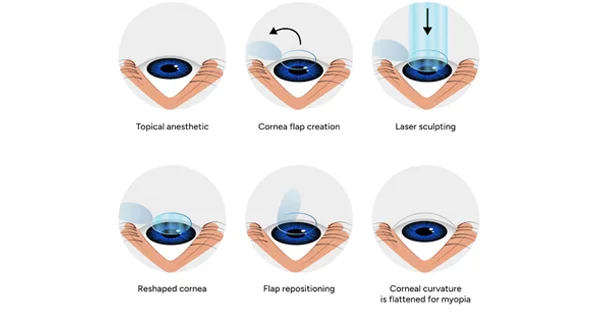
LASIK is usually completed within 15–30 minutes for both eyes.
Step 1: Comprehensive Eye Evaluation
The ophthalmologist evaluates:
- Eye power
- Corneal thickness
- Corneal shape
- Tear production
- Overall eye health
Step 2: Numbing Eye Drops
Local anesthetic eye drops are applied to ensure comfort.
Step 3: Corneal Flap Creation
A thin flap is created using a microkeratome or femtosecond laser.
Step 4: Laser Vision Correction
An excimer laser reshapes the cornea according to the patient's prescription.
Step 5: Flap Repositioning
The flap is gently repositioned and heals naturally without stitches.
Age Limit for LASIK Surgery
Most eye specialists recommend LASIK for individuals who:
- Are at least 18 years old
- Have stable eye power for 1–2 years
- Have healthy corneas
- Do not have significant eye diseases
Ideal candidates are generally between 18 and 40 years of age, although eligibility depends on overall eye health rather than age alone.
Who is a Good Candidate for LASIK?
You may be suitable for LASIK if you:
- Wear glasses or contact lenses
- Have stable vision prescription
- Have healthy corneas
- Are not pregnant or breastfeeding
- Do not have severe dry eyes
- Have realistic expectations
A detailed eye examination is necessary before surgery.
Benefits of LASIK Eye Surgery
LASIK offers several advantages:
- Reduced dependence on glasses
- Reduced need for contact lenses
- Quick procedure
- Minimal discomfort
- Fast visual recovery
- Long-lasting results
- Improved quality of life
- Better convenience for sports and active lifestyles
Many patients achieve 20/20 vision or better after treatment.
Recovery After LASIK
Recovery is generally very fast.
First 24 Hours
- Mild irritation or burning sensation
- Watering of eyes
- Light sensitivity
- Blurred vision initially
First Week
- Vision improves significantly
- Most patients resume work within 1–3 days
- Eye drops are used regularly
First Month
- Vision continues to stabilize
- Follow-up visits monitor healing
Long-Term Recovery
Most patients enjoy stable and clear vision for years after the procedure.
Side Effects of LASIK Eye Surgery
Most side effects are temporary and improve as healing progresses.
Common Temporary Side Effects
- Dry eyes
- Glare around lights
- Halos at night
- Light sensitivity
- Mild discomfort
- Temporary blurred vision
Less Common Side Effects
- Fluctuating vision
- Difficulty driving at night during early recovery
- Mild eye redness
Most symptoms resolve within weeks or months.
Risks and Complications
Serious complications are uncommon but may include:
- Infection
- Corneal flap complications
- Under-correction or over-correction
- Persistent dry eyes
- Visual disturbances
- Corneal ectasia (rare)
Thorough pre-operative screening significantly reduces these risks.
Precautions After LASIK Surgery
To ensure proper healing:
- Avoid rubbing the eyes
- Use prescribed eye drops regularly
- Wear protective eye shields while sleeping initially
- Avoid swimming for several weeks
- Avoid eye makeup for a few days
- Wear sunglasses outdoors
- Attend all follow-up appointments
LASIK vs Contact Lenses
| Feature | LASIK | Contact Lenses |
|---|---|---|
| Long-Term Vision Correction | Yes | No |
| Daily Maintenance | No | Yes |
| Risk of Lens Infection | No | Possible |
| Cost Over Time | Often cost-effective | Ongoing expenses |
| Convenience | High | Moderate |
Success Rate of LASIK
LASIK has a very high success rate. Most patients achieve significant visual improvement and reduced dependence on corrective eyewear. Patient satisfaction rates are consistently high worldwide.
Why Choose Beatx Healthcare?
At Beatx Healthcare, LASIK surgery is performed with advanced diagnostic technology and modern laser systems.
Our advantages include:
- Experienced ophthalmologists
- Advanced laser platforms
- Comprehensive eye evaluation
- Customized treatment planning
- High safety standards
- Quick recovery support
- Long-term follow-up care
FAQs
1. Is LASIK surgery painful?
No. Numbing eye drops are used during the procedure, making LASIK virtually painless.
2. How long does LASIK surgery take?
The procedure usually takes about 15–30 minutes for both eyes.
3. What is the minimum age for LASIK?
Most candidates should be at least 18 years old with stable vision.
4. How soon can I return to work?
Many patients return to work within 1–3 days after surgery.
5. Can LASIK permanently remove the need for glasses?
Most patients experience significant freedom from glasses, although age-related vision changes may occur later in life.
6. Is LASIK safe?
Yes. LASIK is considered a safe and effective procedure when performed after proper screening by experienced eye surgeons.
7. Can both eyes be treated on the same day?
Yes. LASIK is commonly performed on both eyes during the same session.
8. How long do LASIK results last?
LASIK results are generally long-lasting. However, natural age-related vision changes such as presbyopia can still occur over time.